Hi, and a confession
Hi — I'm an ordinary person who has raised two dogs. The first was Baicai ("Cabbage"), a stray I took in at about three months old. She was a Chinese pastoral dog: watchful, protective, and blessed with an iron stomach — but she had severe social anxiety in the city. She barked at anyone she spotted from a distance, and for that entire year, not a single guest set foot in my home. When her anxiety peaked, she chewed the fur off her own legs until they were bald. Eventually she moved to my family's place in the countryside — guarding the chickens, soaking up sun, running free — and her coat grew back on its own. This was a personal observation, not proof of the cause of her hair loss; persistent itching or hair loss needs veterinary evaluation.
My second dog, Qiqi, is a Border Collie mix I brought home at weaning age. She's the opposite: outrageously friendly, chased after every person she met, and so picky she'd only eat meat. She also picked up bad habits from other dogs — barking at ones she disliked — and it took until she was a year and a half old to rebuild healthy boundaries with people and dogs alike.
These two dogs taught me one thing: many everyday challenges improve with patient teaching and a safer environment. Pain, illness, fear and separation distress may also need professional help. That's what this 30-day guide is: personal lessons alongside sourced guidance, arranged on a flexible timeline. Start health care and safe socialization early; progress at your dog's pace. The puppy-specific advice below needs adapting for an adult rescue dog.
Before the Dog Comes Home: Get This Gear
Measure your individual dog. Breed labels and S/M/L sizes vary between manufacturers.
| Item | Measure / fit | Before buying |
|---|---|---|
| Bed | Measure your dog lying in its usual sleeping position. | Choose usable interior space that allows comfortable stretching; allow for growth. |
| Crate | The dog can stand naturally, turn around and lie comfortably. | Use the manufacturer's body-length and height guide. An adult-sized crate with a suitable divider can accommodate growth; never crowd the puppy. |
| Travel carrier | Check standing height, body length and weight against interior dimensions. | Follow the specific airline or vehicle-restraint requirements; a 48-inch carrier is not universal approval. |
| Collar | Measure neck circumference and check a comfortable two-finger fit. | Use that brand's adjustable range; recheck as the puppy grows. |
| Harness | Measure chest girth and any neck measurement required by the brand. | Check for rubbing, escape risk and free movement; recheck after growth. |
How to choose each item
- Dog bed — Choose usable interior dimensions for comfortable stretching, with room for growth (see fit table).
- Crate / playpen — Choose a secure, appropriately fitted resting space. A divider can adjust a larger crate as your puppy grows. Introduce it with rewards; never use confinement as punishment.
- Food & water bowls — stainless steel first (cheap, easy to disinfect, unbreakable), ceramic second. Plastic scratches and harbors bacteria — skip it. Flat-faced breeds (Frenchies / Pugs) need shallow slanted bowls.
- Dog food — Start with the previous complete puppy food. Ask your vet about gradual transition and a growth-appropriate nutritional adequacy statement, including large-breed growth where applicable.
- Training treats — short reward-based exercises can begin in week 1. Small freeze-dried chicken training treats or cheese bits: tiny enough that the dog can eat ten without ruining its appetite.
- Goat milk powder — Not a routine puppy essential. A very young or unweaned puppy needs prompt veterinary feeding advice; goat milk is not a substitute for a suitable canine milk replacer. Pending veterinary review: individual feeding needs.
- Collar — lightweight adjustable nylon. Fit test: two fingers slide flat between collar and neck. Attach a tag with your phone number before the first outing — if the dog ever gets lost, that tag is its only ID.
- Leash + harness — Use a lightweight fixed-length leash and a well-fitted harness. Introduce them in short supervised sessions with treats; avoid leash jerks and unattended dragging. Compare fit and features in our guide to choosing a no-pull dog harness.
- Enzymatic cleaner — Choose a pet-urine enzymatic cleaner suitable for the surface. Follow contact-time, ventilation and drying instructions; keep pets away as the label directs. Odor removal is not the same as disinfection. Do not mix cleaning chemicals; vinegar is not an equivalent enzyme treatment.
- Treat-dispensing toy ×1 — Choose an appropriately sized, durable rubber food toy or snuffle mat. Supervise first and inspect for damage. Food toys do not treat separation distress; avoid fabric that your dog may swallow.
- Chew toys ×2–3 — Offer size-appropriate chew toys under supervision. Remove damaged toys and anything that sheds swallowable pieces.
- Travel carrier (optional) — Use a secure carrier or appropriate vehicle restraint for transport. Check the actual dimensions and transport requirements; do not carry a loose puppy in a moving car.
As an Amazon Associate, DogCare Guide earns from qualifying purchases. This does not affect your price.
My hard lesson: my first dog was a total surprise — a stray I met on the street and brought home the same day. Nothing prepared, not even a leash, so I carried her outside wrapped in an old jacket. She was terrified and kept crying; my arms ached and she suffered. Everything else can wait — but get the leash in advance.

First 24 Hours: A Quiet Start
Focus on safety, toilet breaks, food, water and rest. Save busy introductions for later. Arrival day is day 1 at home, not a puppy-age milestone.
First 24 Hours Quick Checklist
- Puppy-proof one quiet area; put away cords, medicines and swallowable objects.
- Offer the previous food and fresh water; collect feeding, vaccine and parasite records.
- Show the potty spot on arrival and after waking; reward successful toileting immediately.
- Keep greetings quiet and supervised; give the puppy uninterrupted rest.
- Arrange a vet check in the next few days; save daytime and emergency clinic numbers.
- Set up a comfortable sleeping space nearby; respond to nighttime toileting or distress needs.
Week 1: Safety, Potty Routine, Vet Check + Safe Socialization
Build trust from day one with tiny reward-based lessons. Do not postpone health care or all socialization until week 4.
Potty timing starts now
Take the puppy to the potty spot immediately on waking, after play and soon after drinking. After meals, offer a break within about 5–30 minutes, sooner for a younger puppy. While awake, initially offer frequent opportunities (around every 30–45 minutes for a very young puppy) and adjust using your log; this is a starting plan, not a holding-capacity promise. Sniffing, circling or restlessness means offer a break now. Arrange overnight breaks as needed.
Reward as soon as the puppy finishes in the chosen spot. After an accident, clean calmly with a pet-urine enzymatic product following its label. Never punish or restrict drinking water to prevent accidents. If your routine includes an indoor potty area, our puppy pee pad buying guide explains what to look for. Pain, straining or an abrupt change in urination needs veterinary advice.
Family, equipment and rest
Let the puppy approach people voluntarily. Adults supervise children and keep them away from a dog that is sleeping, eating or chewing. Reward four paws on the floor; use a barrier or calmly pause play rather than knee blocks or pokes. Keep fresh water available and confirm meal frequency with your vet and food instructions.
Introduce collar, harness and leash briefly with treats and direct supervision. Remove equipment that could snag during confinement or unattended rest. Use an open crate or pen with voluntary entry, then practice closing it only while the puppy stays comfortable. Never leave a dragging leash unattended.
Safe socialization begins in week 1
AVSAB identifies the first three months as an important socialization window and supports safe exposure before the vaccine series is complete. Try quiet household sounds at low volume, different safe surfaces, gentle handling and watching the world from a carrier. Pair experiences with rewards, allow retreat and stop if the puppy freezes, hides or becomes fearful. Avoid dog parks, unknown dogs and heavily dog-trafficked ground.
Ask your vet which environments and known healthy, vaccinated dogs are appropriate locally. AVSAB describes classes starting at 7–8 weeks with at least one vaccine set given 7 days before class and an initial deworming; local disease risk, your puppy's health and the class's hygiene rules still require veterinary approval. Pending professional review: individual exposure and class-entry plan.
Health planning starts now
Book a checkup in the first few days, bringing previous care records and your observations. Ask about vaccines, fecal testing, nutrition, parasite prevention and local exposure risks. Follow the clinic's sample-storage instructions. Do not wait until day 22 for a first examination.
My story (a dosing lesson): once I read the dose on the label but missed the "give for 3 consecutive days" part, so I gave it one day and basically wasted it. Read the label top to bottom — the duration matters as much as the dose. For dosing, try in order: mix into dry kibble (no water — the pill dissolves); tuck into a chunk of chicken; only then the manual method — open the mouth, push the pill to the back of the tongue, close, stroke the throat.
Personal experience, not a clinical protocol. Ask the clinic how to make your puppy's visit comfortable.
Vaccines: AAHA guidance checked October 14, 2026
The 2022 AAHA Canine Vaccination Guidelines were updated in 2024: leptospirosis is a core vaccine recommended for all dogs, not only dogs visiting lakes or living in rural areas. These US-oriented recommendations need a local veterinarian's adaptation.
| Vaccine | AAHA overview |
|---|---|
| Distemper, adenovirus and parvovirus (combination may include parainfluenza) | AAHA's table lists at least three combination doses between 6 and 16 weeks, 2–4 weeks apart. Have your vet confirm the final puppy dose timing and any extension for local risk. |
| Leptospirosis | AAHA recommends a 4-serovar vaccine: two initial doses 2–4 weeks apart starting at 12 weeks, then a booster within one year and annually thereafter. Product labeling and individual medical circumstances require vet confirmation. |
| Rabies | Follow local law and the licensed product's age and booster requirements; no universal 12-week rule applies everywhere. |
| Lifestyle / exposure vaccines | Discuss Bordetella, canine influenza and Lyme disease according to geography, contacts and activities. |
Unknown history? Tell your vet; do not decide on your own to restart every series. Vaccines do not provide immediate or absolute protection. Ask when each activity is appropriate while continuing low-risk socialization. Pending veterinary review: patient-specific schedule, products, contraindications and regional requirements.
Week 1 Checklist
- First veterinary check completed or promptly arranged; records and next dates reviewed
- Potty routine and appetite/stool log started
- Name response, gentle handling and rewarding calm behavior started
- One brief, pleasant, low-risk exposure recorded at a time
- Comfortable rest space introduced without forcing confinement
Week 2: Reinforce Routines, Recall + Comfortable Alone-Time
Name and recall
Say the name once, then reward looking toward you. Practice a cheerful recall over a short distance indoors. Keep sessions brief and stop while the dog is engaged; consistent cue words help more than a fixed success-rate target.
Keep socialization gentle
Repeat enjoyable exposures, gradually adding variety. Socialization means feeling safe around everyday life, not greeting every person or dog. Adjust distance or intensity when the puppy looks worried.
Alone-time: follow comfort, not a stopwatch
Start with calm independent play while you are nearby, then an absence of a few seconds if tolerated. Return before distress and build gradually using observation or a camera. Toileting, age and individual comfort limit duration. Persistent crying, panting, escape attempts or inability to settle means shorten the next session and seek qualified help. Do not leave a puppy to howl it out, and do not require a five-minute ban on greeting. Arrange a sitter or other support for necessary longer absences. Pending behavior-professional review: separation distress or a tailored training plan.
Week 2 Checklist
- Potty timing adjusted from the log
- Vet-approved socialization continued without overwhelming the puppy
- Recall and leash practice started in a safe space
- Alone-time kept within observed comfort; support arranged for longer absences
Week 3: Essential Life Skills Before Tricks
Practice in short, enjoyable sessions; adjust to attention and comfort.
Sit, recall, leave it and drop it
Reward a comfortable sit without pressing the dog into position. Continue recall in a secure area. Teach leave it with a covered low-value item and a reward for turning away. Teach drop it by trading a safe toy for a treat; do not chase or force objects out of the mouth. Seek professional help for guarding or unsafe swallowing.
Settle, handling and leash skills
Reward voluntarily relaxing on a mat or entering an open crate. Pair very brief, gentle paw or body handling with treats; stop if uncomfortable. Reward walking beside you on a loose leash in safe, vet-approved areas.
Barking and puppy mouthing
Check toileting, discomfort, fear and the environment before asking for quiet. Increase distance from triggers and reward calm attention. For mouthing, offer a suitable chew and calmly pause play if teeth touch skin; avoid startling yelps or physical punishment. Persistent fear, guarding, injury or distress needs professional assessment. For a closer look at everyday barking triggers, see our guide to puppy barking.
Optional later: Shake, Spin and Speak
These tricks are enrichment, not first-month requirements. Prioritize recall, toileting, settling and comfortable handling. Do not provoke barking to teach Speak as a required route to Quiet.

My story: at Qiqi's first vet visit she was tense and trembling, with other dogs barking in the waiting room. What worked: crate door shut, back to the foot traffic, quiet praise whenever she calmed. When the vet went through feeding instructions, I typed everything into my phone's notes — on the walk home I'd already forgotten half of it. Only what I wrote down on the spot actually stuck.
This records what I tried with Qiqi; it does not establish a treatment for barking or anxiety. A crate should remain a voluntary, comfortable resting place.
Week 3 Checklist
- Recall, leave it, drop it and settling practiced with rewards
- Chewing redirected to suitable toys
- Triggers for barking identified; persistent fear or distress referred for help
- Socialization and health follow-up continued; tricks optional
Week 4: Review Progress + Continue Health Care
Check your notes against your dog's age and the vet's plan. The first month may end before the vaccine series does. Keep safe socialization and routine training going; neither house-training nor being alone is guaranteed by day 30.
Parasite and health records
Record each product, administration date, veterinary instructions and next due date. Ask about fecal testing, intestinal parasites, fleas, ticks and heartworm prevention for your region. Products differ in coverage, minimum age and weight; some combine internal and external prevention. There is no universal every-three-months schedule or mandatory one-week gap between products. Do not dose or combine treatments from this article. Pending veterinary review: parasite-prevention plan.
My story: one holiday, Baicai was home alone and appeared anxious; she chewed the fur off her legs and hindquarters. Neither topical nor oral medication helped much. After she moved to the countryside, with more outdoor time and a different routine, her coat slowly grew back. This personal experience cannot establish what caused her hair loss or why it improved. Persistent itching or hair loss should be evaluated by a veterinarian; a change in environment does not replace that assessment.
When to ask for help
Photograph persistent itching, hair loss, redness or discharge and arrange a veterinary assessment; appearance alone cannot distinguish parasites, infection, allergy or stress. Do not wait for a weekly checklist if your dog is unwell. Repeated vomiting, marked lethargy, painful urination or broken/infected skin warrants prompt veterinary contact; trouble breathing or collapse requires emergency care. Pending veterinary review: symptom triage wording.
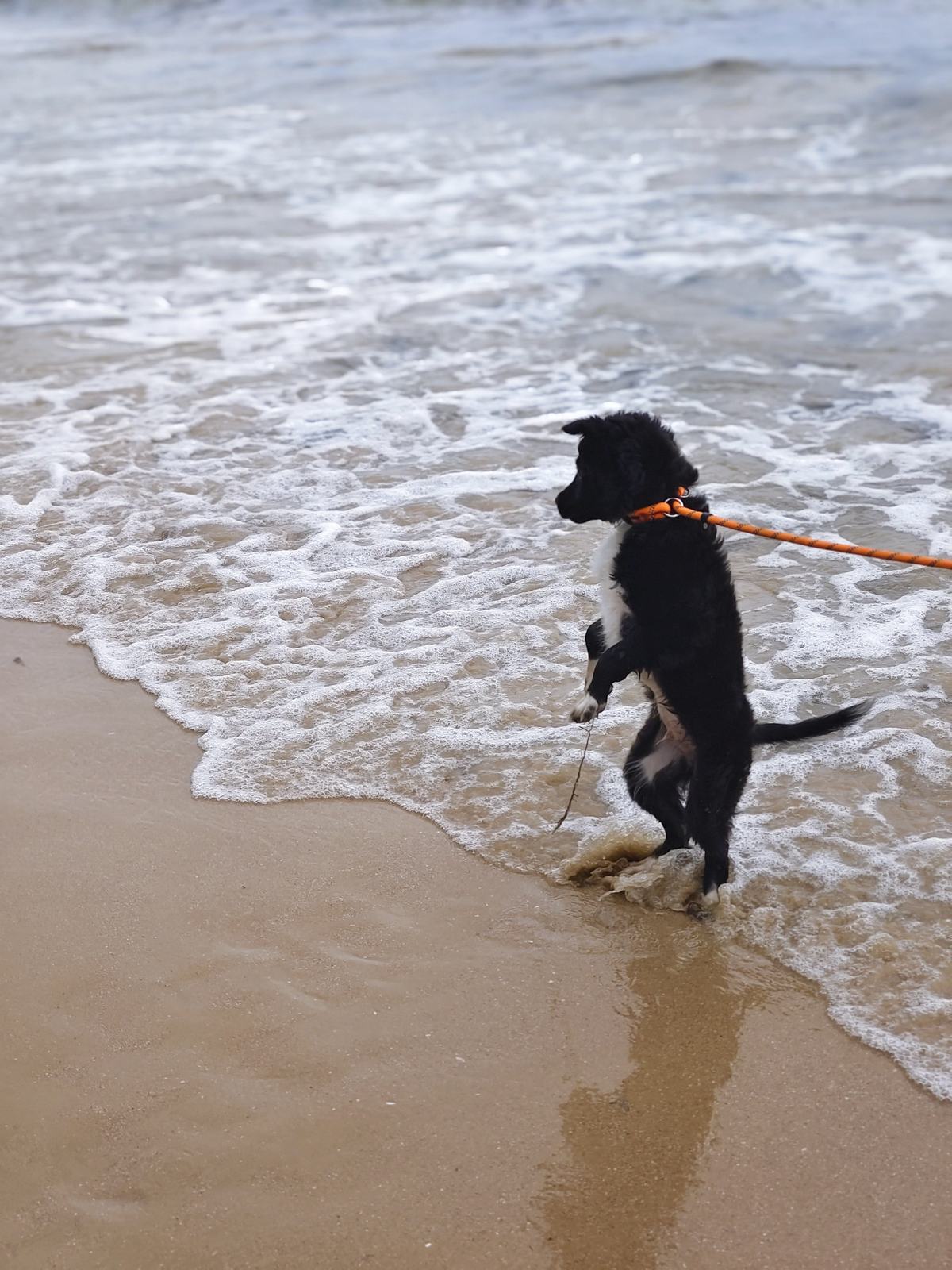
My story: these days, when a truck rumbles past and scares her, Qiqi goes and hides in her crate — her idea of the safest place on earth. And when we leave each morning, she doesn't bark anymore; she plays in the living room or finds a corner to sleep. She knows I leave at this hour and come back at that one. That routine helped us over time. Every dog has a different timeline.
Week 4 Checklist
- Next vaccine and parasite-prevention dates confirmed
- Progress reviewed without a 30-day deadline for house-training or solitude
- Rest, safe exposures and essential cues continued
- Unresolved health or behavior concerns discussed with a professional
Graduation: What 30 Days Got You
- A stable shared routine (it knows when you leave and roughly when you return)
- A name that turns heads
- Early practice of essential cues: recall, sit, leave it, drop it and settling
- A health record (appetite/stool logs + vaccines + deworming)
- A clearer picture of comfortable rest and alone-time, with support where needed
My story: these days, when a truck rumbles past and scares her, Qiqi goes and hides in her crate — her idea of the safest place on earth. And when we leave each morning, she doesn't bark anymore; she plays in the living room or finds a corner to sleep. She knows I leave at this hour and come back at that one. That routine helped us over time. Every dog has a different timeline.
Printable 30-Day Checklist
Start date: __________ Dog / age: __________ Vet / emergency phone: __________
Tick daily care completed or write N/A. Rest and fresh water are daily essentials. Exposure can mean repeating an easy experience; it is not a quota. Alone-time and cues are optional when your dog is uncomfortable. Health concerns override the plan.
| Day | Potty log | Food / water / rest | Safe exposure | Brief cues | Health log | Notes / comfort / accidents |
|---|---|---|---|---|---|---|
| 1 | ☐ | ☐ | ☐ | ☐ | ☐ | |
| 2 | ☐ | ☐ | ☐ | ☐ | ☐ | |
| 3 | ☐ | ☐ | ☐ | ☐ | ☐ | |
| 4 | ☐ | ☐ | ☐ | ☐ | ☐ | |
| 5 | ☐ | ☐ | ☐ | ☐ | ☐ | |
| 6 | ☐ | ☐ | ☐ | ☐ | ☐ | |
| 7 | ☐ | ☐ | ☐ | ☐ | ☐ | |
| 8 | ☐ | ☐ | ☐ | ☐ | ☐ | |
| 9 | ☐ | ☐ | ☐ | ☐ | ☐ | |
| 10 | ☐ | ☐ | ☐ | ☐ | ☐ | |
| 11 | ☐ | ☐ | ☐ | ☐ | ☐ | |
| 12 | ☐ | ☐ | ☐ | ☐ | ☐ | |
| 13 | ☐ | ☐ | ☐ | ☐ | ☐ | |
| 14 | ☐ | ☐ | ☐ | ☐ | ☐ | |
| 15 | ☐ | ☐ | ☐ | ☐ | ☐ | |
| 16 | ☐ | ☐ | ☐ | ☐ | ☐ | |
| 17 | ☐ | ☐ | ☐ | ☐ | ☐ | |
| 18 | ☐ | ☐ | ☐ | ☐ | ☐ | |
| 19 | ☐ | ☐ | ☐ | ☐ | ☐ | |
| 20 | ☐ | ☐ | ☐ | ☐ | ☐ | |
| 21 | ☐ | ☐ | ☐ | ☐ | ☐ | |
| 22 | ☐ | ☐ | ☐ | ☐ | ☐ | |
| 23 | ☐ | ☐ | ☐ | ☐ | ☐ | |
| 24 | ☐ | ☐ | ☐ | ☐ | ☐ | |
| 25 | ☐ | ☐ | ☐ | ☐ | ☐ | |
| 26 | ☐ | ☐ | ☐ | ☐ | ☐ | |
| 27 | ☐ | ☐ | ☐ | ☐ | ☐ | |
| 28 | ☐ | ☐ | ☐ | ☐ | ☐ | |
| 29 | ☐ | ☐ | ☐ | ☐ | ☐ | |
| 30 | ☐ | ☐ | ☐ | ☐ | ☐ |
Milestones to revisit — not pass/fail deadlines
- Day 1: safe area, potty spot, previous food, records and vet booking
- Days 2–7: first checkup, health plan and low-risk socialization
- Days 8–14: routines, recall and comfortable brief separations
- Days 15–21: essential cues, handling and settling
- Days 22–30: review progress; confirm next care dates and needed support
Next vaccine: __________ Parasite follow-up: __________ Questions for vet / trainer: ____________________
Educational checklist; individual health and behavior plans require professional advice. Content checked October 14, 2026; professional review pending.
Sources + Review Status
Content updated October 14, 2026. Written from personal experience; not reviewed or approved by a veterinarian or veterinary behaviorist. Professional review pending for individualized medical schedules, symptom triage, nutrition and behavior plans.
- AKC: First Day at Home With a New Puppy — settling in and early routines.
- AKC: Puppy Potty Training Timeline — post-meal, waking and play breaks.
- AAHA canine vaccination guidelines (2024 update) and core/noncore vaccine table — veterinary planning.
- AVSAB position statements and puppy socialization statement — safe early exposure and reward-based training.
This guide is for educational purposes only and is not veterinary advice. Vaccine and deworming schedules should always be confirmed with your veterinarian, as recommendations vary by region and individual health status.